Visitor Count

VISITOR COUNT:  

counter for blogger

Sunday, April 10, 2011

Bread & Wine

A loaf of bread, a jug of wine and thou beside me, singing in the wilderness’ – The Rubiat

Our summer house is built on farm land that had lots of old apple trees that we have never pruned or picked. Occasionally, when we have a warm enough fall, the fallen apples ferment, and their delicious scent attracts creatures like rabbits, groundhogs and deer. They all have a jolly time getting tipsy as they gobble up this potent gift of nature and later of course, spread the apple seeds in their scat. This was Mother Nature’s whole purpose in the exercise. She also provided the single celled fungi called yeast that get the fermentation going. The yeast cells are so small they are suspended in the air like dust landing on whatever is in the vicinity. In the case of the ripe apples, they were ready, willing and able to consume the sweet juices and in the process produced alcohol and carbon dioxide gas [CO2].

In very ancient times in the various cradles of civilizations, early humans must have found that they too enjoyed the taste and alcoholic effects of fermenting fruit. It turns out that grapes were a fruit of choice, not just for taste but because the air born yeast stuck to their skins ready to start fermentation process as soon as the ripe fruit burst open. As humans are wont to do, they soon were thwarting nature’s original intentions by crushing the fruit and producing wine from the fermented juice. It’s interesting that many vintners still use the strains of yeast that are naturally provided.

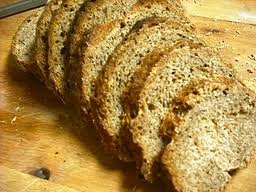
So, as yeast cells in the air provide the wine, so too they play a most important role in providing leavened bread. Our hunter, gatherer ancestors collected seeds to eat and store for lean times and, as early as 9000 BC there is evidence that wild grain seeds were being ground to produce flour. It was easy to mix flour with water and pour it on a hot rock to cook. This unleavened bread soon became a staple in their diet and one can imagine that on occasion a slurry of flour in water must have been left standing for a few day and it began to bubble. That’s because a different strain of yeast that was able to break down the starch in the flour to make sugar and was happily feeding while producing alcohol and CO2 gas. The bubbles got caught in the flour-water slurry making it rise and soon enough some one had learned how to produced loaves of light textured

bread something like we know it today but tasting sour. During the gold rush in the Yukon, the prospectors relied on natural yeasts to produce their sourdough bread. In fact it was 1880 before bread yeast was introduced and sold commercially!

Have you ever noticed that if you smell bread baking when you enter a house, a strong sense of well-being comes over you? That’s because the alcohol - produced by the yeast -. is being vaporized in the hot oven and you’re breathing it in.

Thanks to Nature’s gifts – life is good …and getting better? Rie

Sunday, April 3, 2011

Aging


Aging ain’t for sissies - Betty Davis

We are all unique - first of all because of the genes we’ve inherited and then in the way we treat our living bodies, the only vehicle we will inhabit as we go through life. So it’s not easy to give opinions that predict what aging will be like for everyone who’s fortunate enough to get quite old.

You can get some clues from observing successful old people and recognizing traits they have in common. The big thing is that no matter what their physical condition, most of them seem to be engaged and haven't lost all their zest for life.

In this post I thought I’d write about what my experience has been as I have aged physically. I had two strikes against me from the start – most of my ancestors died young because of heart problems and I inherited that bad gene. Also, I smoked for 30 years before anyone knew how bad it was for the ‘cardiovascular’ system. As was predictable, I did start to have heart problems [angina] in my 50’s but kept them more or less under control by being active, taking medication and watching my diet.

When I was 72 my life was saved by having bypass surgery. To my delight, the operation gave me a new lease on life and, until I was 82, I had almost no reduction in energies or well-being. Since then vigour has begun to wane but, except for the pain of poor circulation in both legs, I experienced no other aches or pains until I hit 85. Now at 86, on a bad day I can feel like the gal in the cartoon. I think it is because I've had to greatly reduce my activities and that has contributed to the onset of general aches and pains. I will begin visits to a swimming pool this week.

As you age you get to internalize and accept the idea of your inevitable demise but it would be very helpful to have an idea of how many heartbeats you have left. If you still have goals, it's also helpful to priorize. It dawned on me this week that I should Google ‘Life Expectancy Test’. Sure enough there are a number of lifespan tests and if you click on the three bits of coloured text you can visit any one or all three and take the tests. I took them all, averaged my results and I may have about 5 more years, if I take care of myself and all goes well.

The thing I liked about the tests is that I learned about the things that all the tests deemed important for long life and, best of all, find I have a control over quite a few of them. If you are younger, even better - check out your lifespan over time

Here’s to long life and living it to the full until the end. Rie

Sunday, March 27, 2011

Stale Bread

Besides food, I store all sorts of other things in my refrigerator –medications, seeds, open printer ink cartridges – anything that may deteriorate at room temperature – but never bread. Bread is a special case and, since it is a staple in our household as it is in most, I decided it was worthwhile to look into why it is that bread actually gets stale six times faster when you put it in the refrigerator!

Hot and cold are nothing more than the speed at which molecules are moving – they move faster when they are hot, and more slowly when you cool them down. When things get hot, their molecules often bump into each other so hard that they cause bonds between atoms holding them together to break. That can cause a chemical reaction between molecules to occur.

It so happens that food ‘going bad’ is caused by both chemical reactions and by bacteria from the air that can get on it and start multiplying. When it’s cold the rate at which these things happen slows way down. So that gives us a big clue that bread going stale has nothing to do with chemical reactions or bacteria and that it’s just something physical that’s happening especially when it’s cooled down.

Bread has a lot of starch in it and those big starch molecules have little electrostatic charges all over them. That makes them attract and hold little charged water molecules that are free in the bread and also in the air. Trouble is that as water molecules stick, the starch molecules get more and more rigid. That’s why bread goes stale. At room temperature it takes a while for bread to go stale because all the molecules are moving quite quickly and the attraction between them is not strong enough, so water molecules can often shake loose.

Put stale bread in the toaster for a minute or so and the water wriggles free from the starch and the bread gets nice and soft. Put the bread in the refrigerator and the temperature is just right for everything to slow down and stick together better – the starch molecules all become very stiff and of course that means the bread has gone stale.

So – what to do?

- Keep bread in an airtight container. That at least keeps water from the air getting trapped by the starch and - it has the added advantage of keeping fungi floating around in the air getting on it and causing mold. Plastic bags work well and, if you’re careful closing them up, almost no air or fungi can get at the bread so it lasts!

- Buy commercial bread – they put some agent in it that keeps it from going stale as quickly as homemade bread.

- If you make your own bread, put a little honey or sugar in it. Cakes don’t go stale nearly so fast because the small sugar molecules attract water better than starch does, and the sugar molecules don’t go rigid.

- Freeze bread quickly so water molecules are slowed down fast and they don’t have a chance to move into the ‘attractive’ positions on the starch.

May your bread never be stale!! Rie

Sunday, March 20, 2011

Faith

Faith is something one believes in, in spite of the fact there may no direct evidence to support it.

I was brought up in the ‘30’s in a small town and everyone I knew was a Christian. I went to church with my family Sunday mornings. I really couldn’t make much sense of some of it, but I tried and I remember how comforting it was to have ‘Faith’ that there was an all-knowing all-powerful heavenly father who watched over me and to whom I could turn for support. Along with a Faith in God, the church answered basic questions like how we humans came to be here on Earth, and what our purpose is. It also gave us a moral code to live by.

In my teens, as I began to learn scientific explanations and how they had been reached, I saw that to accept an irrational belief in the supernatural God would mean having to close down part of my mind even to myself and I just could not go there. That meant facing the reality that I no longer could trust in the support of a loving God, I had no answers to the big questions and that when I died there was no hereafter.

Still, I was young and, as I look back, I had Faith I could find a better philosophy to live by; Faith in the methods of science; Faith that the laws of nature governing what transpired on our planet would be recognized; and Faith that in understanding them, that all the variety and complexity and beauty on Earth could be revealed.

I have lived a long life and realize that the faith I had at 20 has been vindicated many times over. We are all living in an extraordinarily and momentous time in the long history of the world. Many many answers are now available that reveal the fascinating path that nature has taken to bring about the emergence of life in all its manifestations on Earth, finally culminating in human consciousness.

I am an optimist and I have Faith that enough cooperative, environmentally responsible and intelligent humans will become interconnected, that they will find ways to work together to stop the short sighted greed and insanity that is doing the most to destroy our planet. I have Faith a self-sustaining, more equitable human condition will emerge. I don't expect this will happen in my lifetime. Rie

Sunday, March 13, 2011

Spring Thaw


We live in northern climes and we’ve had lots of snow this winter so it’s going to be a long cold spring while it thaws. The very word ‘thaw’ sends a chill through me.

The reason is that, snow is just water in the solid state and it takes a lot of heat energy to release the bonds that keep the water molecules stuck to one another. To heat a gram of water up 1 degree takes only 1 calorie but it takes 80 calories for one gram of snow to melt. Doing my sums I find it requires a whopping 36,000 calories to melt a single pound of snow. That’s enough calories to keep an average person alive and kicking for 18 days!

So where does all that energy come from? Even if the sun shines and you feel its lovely warmth, the gleaming white snow just reflects the sun’s rays away so it doesn’t absorb much if any heat that way. The enormous amount of heat needed to melt our snow in the spring must come directly out of the surrounding air and from us if we don’t dress warmly enough. The spring air will be cold and 'raw' and we’ll have to wait until all the ice and snow thaw before we get the warmth we so eagerly await!

If you have ever wondered why global warming doesn’t seem to be really affecting the temperature much yet, you’ll understand now that it’s because so much heat is absorbed in the melting of the ice caps that we are literally being buffered from the full effects of temperature rise until all the ice is gone. Rie


Click on image to enlarge


Saturday, March 5, 2011

On Being Female


So you're going through the change dear,
how bad can it be?
As you get as old as I am, you get some broad perspectives about the totality of your life and I thought I would write this post on my experience being a female.
A couple of things about females immediately stand out:
1. We have evolved over millions of years for one very specific and important biological role - to bear and take care of the children of our species.
2. Nature has seen to it that we have a natural hormonal system over which we have no control that makes us ready both physically and mentally to fill this biological role.
When I was a young kid, I was a tomboy, feisty and competitive, more interested in sports than dolls. However, much to my surprise as puberty got its grip on me I became subdued, my fantasies were of being overcome by a strong ‘prince charming’. I was ready to marry at 24. It was 1949 and so I did in spite of the real possibility of having to give up a big love of my life – a career in science.
As expected, I soon became pregnant. I wanted children but did not like the process or think much about the reality of the baby. I was so sick with ‘toxemia’ that a premature birth was induced. In retrospect, it was a relatively easy delivery and I was awake and aware through the whole process. Some maternal hormones must have been produced during the labour because I’ll never forget the incredibly powerful feelings that overcame me as my daughter was born - intense love for and protective instincts toward my wee babe. Nothing had prepared me for becoming a full-blown mother emotionally!
As females we are born with all the precious eggs that will be released and have the potential to become a child during our reproductive years. As we age, unlike other cells in our body that are replaced at least every two years, our egg cells are not, so as time passes they are more and more likely to undergo a mutation and the probability of child defects increases.
So, Nature steps in again and new hormonal changes occur, starting usually in the mid to late 40’s, that gradually shut down the menstrual cycle that had been draining energies all those years. Menopause is not pleasant at first but the wonderful compensation is, you gradually begin to feel a new vitality, stamina and drive. You get Post Menopausal Zest [PMZ] - I felt ready for new challenges! My children had their own lives, I was near a good university and I went after that career in science I had given up and it was the best thing I ever did because at 86 my joy in learning are still there.
In this final stage of my life, my competitive spirit is still there too, and I’m fighting old age by exercising, reading and writing. I'm not ready yet to be looked on as the poor old thing who needs taking care of. Maybe that will be the next step I don’t have control over!    Rie

Sunday, February 27, 2011

Mihi Ego Sapio


"Mihi ego video, mihi ego sapio" Plautus - I see for myself, I think for myself

The 1st turning point in my life was the day I was introduced to the Periodic Table of the elements by my chemistry teacher. That was the day I realized that scientists could answer questions about how nature worked and I wanted to be a chemist because that is the science that is central to all basic understanding of the ‘hard sciences’ at the molecular level.
The 2nd turning point was when I met my future father-in-law, Allan, a university professor and a philosopher. He was interested in young people and had learned how to get to know them very quickly by asking a few simple questions:
- His first for me was: ‘What do you want out of life?’ - At 21, I gave a standard and probably expected answer: ‘Happiness’. - His next was: ‘And what do you think will make you happy? - Without thinking I could hear myself saying: ‘Serving others.
That was the Christian dogma that I had been brought up with and although I had rejected belief in a supernatural personal God at that point, I obviously still had not questioned the basic Christian teachings. The fact that Allan found my answer interesting was a turning point because it started me thinking for myself and began the lifelong search for how we came to evolve on this planet, and if there was some purpose for our being here. I figured that if I could find our purpose, that fulfilling that purpose would be the thing that would make me happy.
It has been an unrelenting preoccupied for much of my life and I have been attracted to science as a source for the answer because scientific investigations are, after all, just honest, collaborative and shared quests to probe the mysteries of the natural world. Yet scientific methods have proved so powerful that science has revealed a whole new body of knowledge that can be relied upon. In recent years the stunning advances in our knowledge of evolution is finally providing some answers that satisfy me.
In my blog on ‘Purpose’ I explain how I have came to the conclusion that spending my time trying to understand and to make the world a better place – in other words ‘serving others’ – has proven to be an overall purpose for all of us.
It turns out that socioloists have also done research examining the lives of those who appear to be happy and fulfilled - and they have come to the same conclusion! People who have worthwhile goals related to improving the lot of all living creatures, are the happiest. So the Christian’s message that I gave my father-in-law so glibly as the answer to ‘what will make me happy’ was the right one!
Rie